The Definitive Guide to Forklift Truck Tires
For any business in the materials handling industry, performance and safety of the forklift fleet should be in the forefront. Engines, hydraulics and other skills required to operate the machine system are key, and the underrated component that contributes to the success of the system are the forklift truck tires. Strategic choices are driven by the selection, maintenance and understanding of the forklift tires. Forklift tires are crucial safety measures and using the right tire is strategic for the investment, and productivity and efficiency of the operations.
The essence of this business is that the fleet manager is well versed in all aspects of operations. This is why the purpose of this guide is to unlock the complexities of forklift truck tires. Forklift truck tires have critical differences: science of rubber compounds and grades, and tire treads, among other factors that ought to be considered for maintenance and replacement. We strive to boost the understanding of trained and untrained fleet managers in safety, operational cost, and the performance of the material handling equipment.
Knowing Forklift Truck Tires and Classification
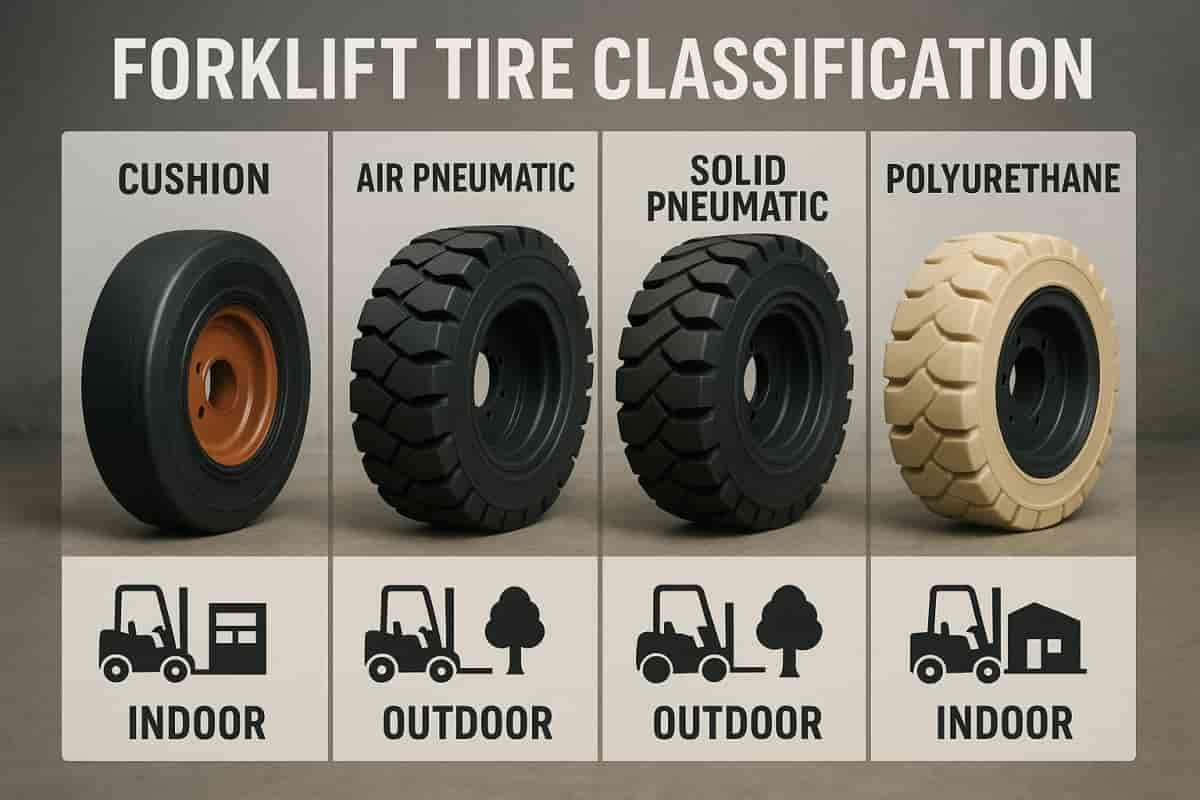
The first and most important part of selecting the right forklift tire is the type of tire and the application it will be used for as well as the surrounding environment. Forklift will most likely be designed for integration with a certain tire type. Though there is some tire type interchangeability, it is rare that one can swap a cushion type tire with a pneumatic type tire and vice versa. Forklift tires can be classified in three main categories: cushion tires, solid pneumatic tires, and air pneumatic tires.

Cushion Tires: Standard Indoor Tires for Smooth Surfaces
Also known as press on tires, cushion tires are usually made from solid rubber tires that are molded and bonded directly onto a steel band which they will be puncture proof and exposed to a rubber outer layer. Cushion tires are considered some of the most durable tires, and, thus, are constructed for specific environments.
Best Applications
Cushion tires are the best tires to be used in complete industrial environments. Forklifts that operate off concrete or well maintained asphalt surfaces regardless of the weight of cargo in all settings, including warehouses, distribution centers and manufacturing centers, will operate efficiently.
Key Advantages
- Exceptional Maneuverability: Forklifts that are fitted with cushion tires are designed with a smaller tire chassis as well as a lower tire chassis which leads to a significantly reduced turning radius. This is highly beneficial for narrow aisle and space navigation.
- Cost-Effectiveness and Longevity: They are typically easier to produce and, when used properly, can last a long of time while requiring little maintenance.
- Stability: The wider base and robust body provide remarkable support for the lifting and shifting of heavy items on flat hard surfaces.
Limitations
The biggest issue with cushion tires is the inability to traverse across diverse surfaces like gravel and dirt, as the rough coarse surfaces can easily damage the tires. Riding on uneven surfaces can be uncomfortable and cause damage to the forklift and the materials being lifted.

Pneumatic Tires: Overcomes Rough and Uneven Surfaces
Pneumatic tires are built for rougher and more diverse conditions outdoors. They are wider than cushion tires and have a deeper tread, which allows for more shock absorption on uneven surfaces. There are two distinct types of pneumatic tires: solid and air-filled.
1. Air Pneumatic Tires
Air pneumatic tires are designed similarly to car or truck tires, which are made of thick rubber and designed to be filled with air. Their air-filled structure is both the biggest advantage and disadvantage.
Best Applications
These are best suited for the outdoors in lumber yards, construction sites, and areas where there is gravel, dirt, or any other rough terrain. They are also useful indoors for a variety of tasks.
Key Advantages
- Superior Cushioning: The air inside the tire provides the entire operator with a smooth and comfortable ride, thus acting as a powerful shock absorber. Operator fatigue is reduced and the forks, load and other components of the forklift are protected from the harmful impacts and distorted vibrations.
- Excellent Traction: Deep treads and air-filled tires are flexible, thus providing a solid grip even on loose and rough surfaces.
Limitations
Their tendency to become flat, the inability to recover from punctures from nails, screws, and sharp debris works of a rough ground is the greatest disadvantage. They include flat tires which is a source of time downtime as well. Regular maintenance is also required to keep the inflation pressure at the desired level.

2. Solid Pneumatic Tires
Also known as resilient tires, solid pneumatic tires offer a middle ground by merging the shape and size of a pneumatic tire with the puncture proof quality of a cushion tire. They are completely made of solid rubber but are designed to perfectly sit on wheels meant for pneumatic tires.
With no doubt, the most versatile and popular tire today is the solid pneumatic tire. It is quite performing in controlled and extreme punishing environments with immense amounts of debris like recycling facilities, scrap yards and lumber yards. Puncture resistance is also a very important feature and this tire does the job well. It is absolutely no problem for these tires to be used indoors and outdoors.
Self-explanatory is the phrase, “Indestructible performance.” Flat tires simply do not exist since they are constructed with solid rubber. This stops downtimes from prolonged flats.
Another point to be made is these tires are extremely durable. As a matter of fact, they outlast air pneumatics, therefore, do last much longer with the corresponding initial price value, are quite worth it.
The primary trade off to be considered is the performance of the ride. Air filled tires tend to be much more cushioned, therefore, the ride is more pleasant for the operator. Although more capable than cushion tires, they do not offer the same amount of shock absorption as the air filled ones on extremely rough terrain.
Specialized Polyurethane Tires
The best examples of these are the press on tires made exclusively for indoors on highly smooth surfaces, for example pristine floors in warehouses.
The target devices for these tires are commonly used in warehouses, like electric pallet jacks, order pickers and reach trucks.
Key Advantages
- High Load Capacity: A polyurethane tire can handle more weight than a similarly sized rubber tire.
- Durability and Resistance: Tires can resist chunking and tearing on clean surfaces and have a longer lifespan than rubber cushion tires.
- Low Rolling Resistance: This feature can extend battery life on electric forklifts.
Limitations
These tires are the harshest type. Even small pieces of debris can inflict considerable damage to the tire. The ride is harsh, given the minimal shock absorption the tire provides. These tires can only be used in clean, smooth, indoor spaces.
A Deep Dive into Tire Compounds and Their Importance
A tire's performance is not only dependant on the type of tire used. The specific rubber compound used to build the tire greatly impacts its performance as well. Several rubber compounds are designed for a specific operating environment, and in turn affect operating durability, tire cleanliness, and more.
Standard Black Rubber: The All Purpose Workhorse
Most forklift tires are constructed using a blend of natural rubber and a carbon black to create a standard black rubber compound. It is an effective and dominant material because it greatly enhances the strength, durability, wear, and UV resistance of the tires. It provides a balanced performance for a wide range of general purpose uses.
Non-Marking Tires: When Cleanliness is Critical
Some industries absolutely cannot afford to have any black markings on the warehouse floor, and for this purpose, non-marking tires are the answer. They are specifically engineered for applications where the cleanest of floors are a core requirement.

How They Work
To achieve the non-marking attribute, the carbon black is substituted for silica or other chalk-based materials. They achieve a predominately grey or white tire and are able to accelerate and decelerate sharply, or spin in tight circles, without leaving any black streaks. They may, however, deposit a fine white dust that is easily wiped up.
Common Applications
In the food and beverage industry, pharmaceuticals, retailing, and paper producing, these tires are a necessity to avoid the risk of black dust causing contamination.
The Good Side and The Bad Side
- Advantages: Saving on cleaning from the prevention of black marks on the floor from the floor tires is the key benefit provided. They also stop the contamination by the carbon dust settled on the floor and in the area.
- Disadvantages: The price is usually associated with the value of the tire. Non-marking black tires which are softer compounds are exhausted at a quicker pace, in some cases up to 25 percent quicker. The price for a carbon black tire is less and is the more economical purchase.
Specialized Compounds for Unique Environments
In addition to the standard and non-marking options, Anti-Static/Conductive Tires are provided for the protection of explosives because they ensure the protection of static-sensitive equipment by engineered tires with compounds that prevent the dissipation of sparks.
Cold Storage/Freezer Compounds
The compound that rubber is made of freezes at a temperature above 32 degrees Fahrenheit and can crack. These rubber compounds can withstand extremely low temperatures and do not become brittle, providing a freezer of value with proven performance.
Chemical-Resistant Compounds
Compound available for the application more focused on tires in chemical plants or for enterprises specializing where they are at risk of being damaged from severe chemicals. These tires are made of specialized compounds, which endure and cease the tires from degrading and chemically burning.
Forklift Truck Tire Tread Patterns and Sizes
Traction, stability, and machine compatibility are all determined by the size and tread pattern of a forklift tire.
Selecting the Tire Tread Design
The section of a tire tread pattern that touches the floor has a traction and a smooth tread design.
Smooth Treads
Most tires in this category have treadless surfaces and are the preferred ones for dry, indoor application by cushion tire forklifts. Smooth treads facilitate maximum floor contact, thus increasing stability and having a longer lifespan and more rubber. They are suited for steer axles of all forklifts.
Traction Treads
These tires have deep grooves and lugs that assist in the grip of a taction on several surfaces. They are important for outdoor applications, and slack rubbers, and in all other situations needing grip. Smooth tires, however, are more efficient and last longer than versions that are rough when used in standard indoor warehouses.

How to Read Forklift Tire Sizes
Knowing the numbers printed on the sidewall of a forklift tire is important for ordering the replacement tire. The notation for sizes is different for press-on (cushion) versus pneumatic style tires.
Cushion (Press-On) Tire Sizing
Dimensions for a press-on tire is noted as: (Overall Diameter) x (Width) x (Inner Diameter).
Example: A tire with markings of 21x7x15 is 21 inches tall, 7 inches wide, and sits on a 15 inch wheel hub.
Pneumatic and Split Solid Pneumatic Tire Sizing
Dimensions for these tires are commonly noted as: (Width) x (Rim Diameter). There are some exceptions for lower profile tires, which may also include total diameter.
Example (Standard): A tire with markings of 28x9-15 is 28 inches in overall diameter, 9 inches wide, and fits a 15 inch rim.
Example (Metric): A tire with markings of 200/50-10 has a section width of 200mm, 50% ratio, and fits a 10 inch rim.
Always check the owner’s manual of the forklift to ensure you have the right size and also, look on the sidewall of the current tires as a reference. It is also important to remember that the rear and front tires do not have to be the same, but tires on the same axle must be the same type and size to avoid damaging the drive train and for stability of the equipment.

The Tenets of Forklift Tire Maintenance and Safety
Proper upkeep of tires and fleets is directly correlated to the operational safety and efficiency of the entire business. Maintenance does not exist in a vacuum; operational downtimes and unsafe workplace conditions can all stem from a failure to practice upkeep.
The Daily Pre-Operation Inspection
Inspections are the first line of defense to mitigate the likelihood of problems arising, especially with the tires. For any shift, any operator should dedicate time to a thorough inspection, with tires being one of the key areas of focus.
What to Monitor For
- Correct Inflation (Air Pneumatics): For tires that are filled with air, the pressure should be checked on a daily basis. Stability and heavy wear can be the result of under-inflation, while a lack of traction and a possible blowout can stem from over-inflation.
- Cuts, Cracks, and Chunking: Inspect the surface and the sidewalls of the frame. Look for deep cuts that expose internal cords, significant cracking, or areas in which chunking of rubber are a loss.
- Embedded Debris: Inspect the treads for nails, rocks, glass, or other items that can lead to additional damage.
- Uneven Wear: Forklift problems where there is an observable patch in a wear and tear pattern can lead to the conclusion that there is an alignment issue that requires attention.
- Flat Spots: Braking too hard or skidding can give rise to flat spotting, which can lead to an unstable and bumpy ride.
Knowing When to Replace a Forklift Tire
The safety hazard that worn out tires can cause cannot be understated. Working with a safety hazard compromises stability, even worse, breaking efficiency, also increases strain to both the machine and the operator. Here are some symptoms that give a better idea as to when a forklift tire needs replacement.
The Wear Line (Safety Line)
A number of solid and cushion tires are designed with an indicator line often labeled as the “60J line” which shows the tire has reached the borderline of safety which in turn means the tire needs to be replaced. Continuing to work with the tire beyond this line compromises the tire's ability to withhold a load.
The 2/3 Rule for Cushion Tires
In regards to smooth press-on cushion tires, a good rule of thumb is to replace the tire once it has lost an equivalent to a third of the rubber's original height.
Tread Depth on Pneumatic Tires
Pneumatic tires require replacement once the tread pattern is worn down. Bald tires cause a reduction of traction, the ineffectiveness is even worse in wet and outdoor conditions. Immediate replacement is warranted on tires with visible damage, for example bulges or exposed cord plies.
Structural Degradation
The tire should be removed from service if it shows any major structual signs of degradation, including deep cracks and/or chunking, regardless of the amount of usable rubber that may be remaining.
Forklift Tire Replacement Requirements
The rest of the section outlines the specific skill set and equipment necessary to carry out the replacement.
A hydraulic press is necessary to replace a tire, unlike regular car tires, which can be removed without specific equipment. Solid and cushion forklift tires are fitted to the rims of the wheel under tremendous pressure, so hydraulic devices are needed to effectively replace the tire.
Replacement should be done under the supervision of a technician, who has the skillset to do so.

Conclusion: Strategic Asset Management Potential of Forklift Truck Tires
Like any other component of a forklift truck, selection and servicing of the tires has more value than the bare minimum operational efforts. Selection and servicing of the tires has functional value and contributes to the overall safety and productivity of material handling at a reasonable cost. Shifting focus and not limiting the tires to consumable items and recognizing their value as an engineering item, gives a new perspective on improvement opportunities to be harnessed.
By choosing a specific tire for a particular purpose, we illustrated the benefits of maneuverability, comfort to the operator, and tire longevity. Cushions, solid-pneumatic, and air-pneumatic tires are some of the varieties we have discussed. We discussed the engineering and chemical make-up of rubber, and how compound selection can assist in tailored solutions for an industry that require Marketplace black rubber, as a standard, and specialist clean, non-marking options. You can capture the value of understanding to analyze and determine the size and diameter of the tire required to maximize performance from the machine.
As a matter of fact, we have a well-defined system in place for upkeep and replacement. A culture of effective daily monitoring and the mastery of wearing indicators like the safety line enables tire management to change from an expense to a strategy. Not only does the approach enhance the value of your investment, but, more importantly, it enhances the safety of your operators and the overall stability of your operation.
As such, this approach to forklift tires offers a plethora of benefits to an operation: reduced downtime and fuel and energy inputs, increased operator safety and comfort, and enhanced longevity of the forklift. Investing in tires suited for the application encourages the operator to invest in strategies that enhance productivity and safety, as well as improve operational effectiveness. This is primarily achieved through collaboration with professionals in the field.
facebook linkedin
Looking for Factory-Direct Tires for Your Fleet?
Get instant wholesale specifications, custom branding, and mixed-container shipment plans.
Contact Engineering →