Solid Tires for Wheel Loaders Creating Zero-Downtime Performance in Challenging Conditions 2026
contact us witha whatsapp
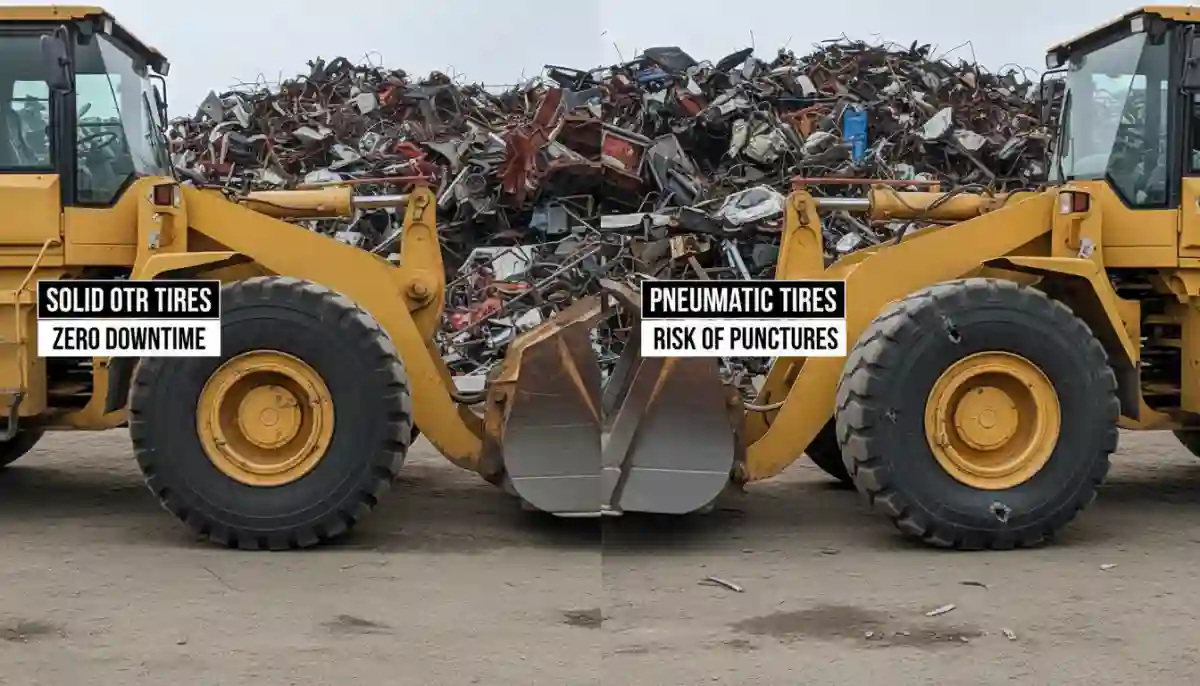
Choosing solid tires for wheel loaders is a choice to remove all unscheduled downtime for any continuous operations in all extreme, aggressive, and puncture-infested environments. Solid OTR (Off-The-Road) tires, also referred to as airless tires or puncture-proof tires, are one of the specialized non-pneumatic tires for severe-duty applications. We understand that the first solid wheel loader tires expense for your business is significant, especially as the solid tires are intended to eliminate the largest cause of operational stoppages in waste management, scrap handling, and severe recycling facilities. This expense can provide a quick return by minimizing labor costs and increasing asset utilization. We focus on the technical matching of the robust, high load capacity tires to the most economically challenging duty cycles to provide the most unmatched durability for the lowest Total Cost of Ownership (TCO).

Understanding the Engineering of Solid Tires for Wheel Loader
Solid tires rely on their construction and weight. There is no air pressure to engineer in; instead, the dense, engineered rubber compound is modified. This should help to understand the basic engineering.
No Air, All Mass
Solid wheel loader tires are defined by the fact there is no air in the tires. There is dense rubber compound, and sometimes additional structural rubber components to assist with the mounting and help with load distribution.
Absorbing and Withstanding Impacts
The resilience of the rubber compound is engineered to be tougher and more cut-resistant than the compound used on the tread of the most aggressive L5 pneumatic tire. This means the solid OTR tires rubber compound will be able to handle the impact of sharp metal, rebar, glass, and solid rock fragments. There is no penetration or pressure loss and the rubber compound will absorb the impact. Therefore, the volume of rubber will sacrifice itself against any sort of abrasion and tearing.
Most solid wheel loader tires are designed using an intermediate steel band as a permanent attachment to a standard pneumatic wheel rim creating a virtually inseparable unit. This type of attachment is termed press fit. This type of fit ‘frame’ fit is critical to the secure mounting of the tire as the high torque and dynamically loading side-shear forces during aggressive steering are more than enough to shear off a loosely fit press band. This is critical given the enormous weight of the tire and the material being moved.
Load Carrying Capacity: Unmatched Stability and Integrity
The solid tires when mounted on large wheel loaders working with dense/heavy materials have an unmatched load carrying capacity. The solid tires principal advantage is to eliminate the risk associated with overinflation and hence the risk of load failure. The load on a solid tire is carried through the physical properties of the rubber tire. It’s not air pressure. Therefore, solid tires will always keep the ideal geometric shape for any imposed load, completely eliminating the risk of sidewall failure under extreme over-pressure, which is a common risk with pneumatic tires while working with very dense materials such as steel slag or iron ore.
Stability for High-Lift and Tipping Loads
The absence of air cushioning means that solid tires offer a firmer and more stable base for the wheel loader. This additional rigidity will become even more important for applications where the loader lifts loads to full height and lowers the load, and the rigid base will roll or sway the machine to the operator’s confidence and mitigate dangerous tipping moments.
Solid Tires for Wheel Loaders: Non-Negotiable Operational Environments
It is in extreme-duty environments where solid tires become cost effective for use on wheel loaders, and the MTBPF for pneumatic tires is ridiculously low and unacceptable for these use environments. This is where we focus this technology.
Waste Management and Landfill Operations
Pneumatically tired loaders face the most certain risk of a puncture in these environments every few hours of operation. Solid wheel loader tires eliminate that risk. The rest of the day can be spent working without the need to bring in a repair crew.

Heat Management in Compacting
When heat is added in compacting tires, there is also some chemical reactions. Then, there is solid tires. They make internal heat from flexing and do not undergo catastrophic failure. They flex, make, and maintain internal heat under very high unwavering media. Then, there is solid tires. They make internal heat from flexing and do not suffer catastrophic failure. They flex, make, and maintain internal heat under very high unwavering media. Then, there is solid tires. They make internal heat from flexing and do not suffer catastrophic failure. They flex, make, and maintain internal heat under very high unwavering media.
Scrap Metal and Recycling Yards
Ultimate Defense Against Metal Shreds
Scrap yards, particularly those handling ferrous metals, are the most hostile environments for any rubber product. Shredded steel, cable fragments, and high-tensile rebar are constant enemies. The L5S (Smooth Extra Deep) solid tire is the industry standard here, offering the maximum available rubber volume to resist the grinding, tearing, and cutting forces exerted by sharp metal, ensuring the wheel loader remains fully operational during the most aggressive sorting and loading cycles.
Steel Mills and Slag Handling
High Heat and Material Vulnerability
Handling steel slag and molten steel involves extraordinary high temperatures, and piled slag gets very hot too. Slag handling requires immediate containment, so special manufactured tires are more hot surface resistant than pneumatic tires. Specialized solid tires are made with high density rubber which prevents gas pocket melts and the loss of pressure pneumatic tire would face if a molten hot fragment penetrated the tire. Tiers on wheel loaders have special solid tires manufactured with high density rubber to withstand the high temperatures hot slag gets, negating the need to gas pocket melting of a pneumatic tire. Due to the large volume of hot slag, specially made tires with high density rubber which prove to withstand high temperatures are used on wheel loaders.

Tunneling and Underground Mining
Abrasion and Scuffing Resistance
In underground operations, loaders frequently operate in tight confines, causing significant wheel spin and scuffing on rock surfaces during turning and digging. The L5S solid tire offers a massive rubber block that covers the entire tire in rubber, countering intense abrasion, and maximizes wear life, especially in the high abrasion areas. Standard tread patterns only expose little rubber and wear rapidly in the first edge.
The Trade Off of Solid Tire Performance
The solid wheel loader tire are made with the highly calibrated rubber. These and other solid wheel loader tires are made to withstand extremely high temperatures and during the time of procurement, the minimal performance trade off of the solid tires are to be made.
Ride Quality and Operator Comfort
The solid tire has no pneumatic cushions. Thus, no tire presents solid every pneumatic shock and vibration. The ride becomes harder, and more strain is felt directly by the machine and the operator.
Mitigation Technology
To counter the comfort limitations of solid tires, we can recommend two solutions:
Aperture or Cushion Holes
These designs incorporate precisely engineered elliptical or circular voids (apertures) molded into the tire's sidewall. These holes allow the dense rubber to flex inwards under load, mimicking the cushioning effect of air without compromising the puncture-proof nature.
Two-Stage or Three-Stage Construction
These tires are built with distinct layers: an extremely hard, high-density base compound for rim security, a softer, resilient middle layer (the "cushion" layer) to absorb shocks, and a high-abrasion outer tread layer. This layered approach provides the necessary shock absorption without sacrificing the tire's core durability.
Speed and Haul Distance Limitations
Solid tires are purposely built for slow-moving high-torque applications. Solid tires will generate more internal heat because they are heavier and their flexing is of lower heat and high sustained speeds. This is different from pneumatic Radial tires during sustained high speeds.
Application Restriction
For long-haul transport, do not use solid wheel loader tires. These tires work best when used for short, high-intensity loading, scooping, and dumping cycles within a 100-meter radius. Even with high puncture risk, protected and heat-rated L5 Radial pneumatic tires are still recommended for sustained travel. However, TMPH limits need to be followed.
Financial Analysis: Total Cost of Ownership (TCO) for Solid Tires
The greatest reason to get solid tires for wheel loaders is the cost savings. It is not the purchase price, but the savings that come from having no operational down time and solid tires lasting a long time.
The Cost of Punctures
You have to consider the cost a puncture will bring when evaluating the TCO. It becomes financially damaging when a wheel loader has a single flat tire due to:
- Lost productivity when the wheel loader is not operational.
- Labor costs from the idle operator and the supporting crew being idle (truck drivers, sorting personnel).
Repair/Replacement Cost
Replacement costs are tracked on the pneumatic tire for the field service truck; specialized labor costs, along with the time it takes to travel to the job site, are included in the price too.
Unpredictable Cost-Per-Hour Gain & Unpredictable Revenue Loss
In the first three months of operation, a single pneumatic tire can lose revenue so easily that it costs three times the purchase price. Downtime due to punctures which is common in scrap yards is easily mitigated with solid tires, which keep your costs predictable.

Longer Life, Predictable Replacement
In a harsh environment, a solid tire for a wheel loader can outlast three to five pneumatic tires.
- Predictable Replacement: Largely due to the modular construction of usable rubber, only the tread depth affect the lifespan. A substantial part of the tire can be worn down before the cushion is compromised. Therefore, it becomes easier to determine the replacement cycle, which eliminates replacement in the costly reactive nature of pneumatic tires.
- Inventory and Overhead Maintenance: The need to manage inventory of spare tubes, liners, and inflation devices, along with patching supplies, is eliminated which greatly declines operational overhead.
Procurement and Technical Specification for Solid OTR Tyres
When obtaining a solid tire, one must consider rigorously the size, compound, and mounting specifications.
Standard Sizes and Rim Compatibility
Solid tires are produced for standard rim sizes for the most widely used wheel loaders. Common sizes for solid wheel loader tires are:
- 17.5-25
- 20.5-25
- 23.5-25
- 26.5-25
It is very important to check that the press-on band and the tyre's bead seat diameter are matched to the multi-piece rim of the wheel loader. Inaccurate matching may cause dangerous slippage or early band failure.
Compound Selection: Hardness and Heat Rating
Different compounds are used for solid wheel loader tires and include:
- Abrasion-Resistant Compounds: These compounds contain the highest hardness (durometer) rating and provide maximum protection against cutting and chipping. This is most beneficial for use with rock and scrap.
- Heat-Resistant Compounds: Specifically designed for use with solid wheel loader tires, they include ingredients that minimize heat retention within the cushion layer. This is essential for short-cycle operations which involve higher speeds or loads as they prevent softening and structural failure.
- Specialty Non-Marking Compounds: Specialty Non-Marking Compounds are used in industrial applications, when the zero puncture benefit is needed and the black markings on floors are to be avoided.
We align the compound to the site-specific failure analysis to make sure the tire structure is suited to the dominant environmental stressor.
Installation and Safety Procedures for Solid Wheel Loader Tires
Solid wheel loader tires need to be installed with the use of dedicated hydraulic equipment and are subjected to a high level of safety measures.
The Pressing Process
Solid tires need to be mounted with a hydraulic press because air-pressing with a tire-press is not possible. Solid tires are mounted to the rim using a high tonnage industrial tire press.
Specialized Equipment
This process requires a specialized OTR tire press which is capable of using hundreds of tons of force to guarantee that the tire is locked securely to the rim. We provide this specialized equipment and certified personnel to perform the installation in a safe and precise manner, at our local service center or through a mobile unit that can handle large tyre sizes.
Ongoing Safety Issues
Failure to maintain properly controlled conditions during the pressing process can lead to rim damage and bead seat failure. Also, poorly pressed solid tires can become operationally hazardous as they are unstable and become worse as they are dynamically loaded.

Conclusions – The Start of a Strategic Partnership
Having solid tires fitted to your wheel loaders signifies a transition to guaranteed performance as the tires move the fleet to a phase of solid proactive maintenance. Understanding the severity of your operational environment is the basis of your custom-engineered solid tire solution. It eliminates the unpredictable pneumatic solid tire failure. We have all sizes and application-specific solid tire rubber compounds, suction aperture designs as well as certified installation and lifecycle management. Our solid tire solution is all about marketing zero-downtime productivity as your operational Cost-Per-Hour is minimized and asset utilization is maximized.
Looking for Factory-Direct Tires for Your Fleet?
Get instant wholesale specifications, custom branding, and mixed-container shipment plans.
Contact Engineering →